Packaging is the only part of the product that the customer throw it away within thirty seconds, and it's also the first thing he sees. This contradiction explains why so little investment is made in it and why it's one of the few areas where the environmental impact can be improved without remaking the product.
Since I started shipping wooden objects, I have removed the polystyrene: I have switched to a plastic-free packaging. Not because it's eco-friendly: because complaints were coming in. I'll tell you what really works, what it costs, and where it goes wrong.
Styrofoam protects, but customers hate it.
Expanded polystyrene is an excellent technical material: lightweight, shock-absorbent, and economical. It has three problems that aren't related to protection.
It crumbles. Static balls end up everywhere, and the customer ends up cleaning the floor to open your package. It's the kind of annoyance that always ends up in reviews.
It's hard to dispose of. Formally recyclable, in most Italian municipalities it ends up in the unsorted waste because it is bulky and dirty.
Communicate the opposite of what you sell. A solid wood cutting board, presented as a natural and durable object, emerging from a cloud of white plastic: the message contradicts itself, and the customer registers it even without thinking.
What do I use instead, in order of usefulness?
Crumpled kraft paper. It's a direct substitute for loose fill. It's inexpensive, can be crumpled by hand or with a hand-cranked machine, and absorbs shock by deformation. It needs the right weight: under 70 g/m², it provides bulk but lacks protection.
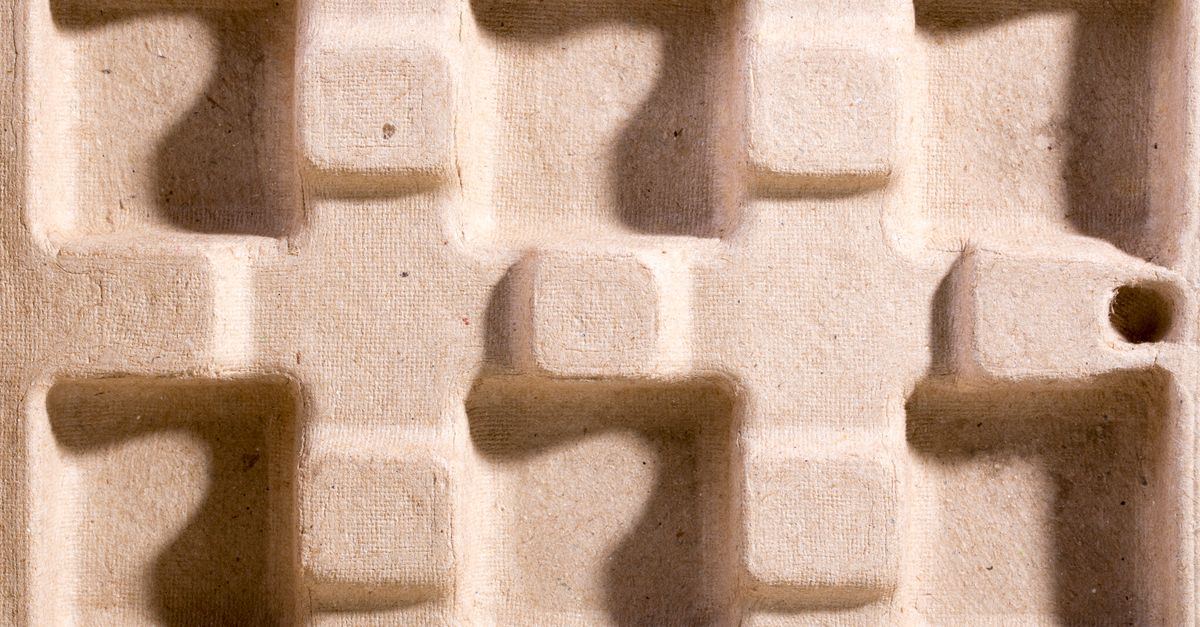
Double-wave corrugated cardboard for the bottom. For a heavy, flat object—a cutting board or pastry board—the critical point is the corner. Two layers of shaped cardboard on the bottom and short sides absorb the impact of a fall better than any filler.
Gummed paper tape. It's the only tape that allows you to declare the box fully recyclable without having to remove anything. It costs more than PPL and requires a dispenser to wet it, but it seals better on recycled cardboard.
Pressed cardboard corners. On more delicate products, they replace the polystyrene corners with an almost identical result.
What I completely eliminated: bubble wrap, Styrofoam chips, PE bags for the individual piece, plastic tape.
Does it cost more? Yes, and it's still worth it.
It must be said honestly: Plastic-free packaging costs more for the same protection, between 15 % and 30 % more per package depending on the format. Anyone who says otherwise has never done the comparison.
But the bill doesn't end with the cost of materials. The savings on the other side must be budgeted for:
- Returns for damage. Just one return out of a hundred shipments wipes out the savings on all one hundred, because it includes the product, outgoing shipping, return shipping, and handling.
- The reviews. «Arrived perfect, packaged very well, no plastic» is a phrase that appears spontaneously and influences the reader.
- The packaging tax. With EPR requirements on packaging, every kilogram of plastic released for consumption has a reporting and tax cost. Less plastic, less tax, and fewer paperwork.
On a cutting board sold for 30 euros, the paper packaging weighs about 40-60 cents more. A return costs 15 cents.
The mistakes I see most often
The box is too big. This is mistake number one. More empty space means more filler, more volumetric weight, higher shipping costs, and a greater chance of the contents shifting. It's better to have three suitable box sizes than one "one size fits all.".
The bottom is not reinforced. Packages fall, and they always fall still, vertically, onto the bottom. If the reinforcement is on the sides and not underneath, it's useless.
No evidence of a fall. Before adopting new packaging, they take three packages and drop them from a meter onto three axes. It costs half an hour and three products, and it tells you what you'd otherwise learn from customers.
The missing communication. If you've removed the plastic, write it down: on a line on the card and on a card in the package. Not as an environmental slogan, but as practical information: "Paper and cardboard packaging, completely recyclable, including the tape." Those who care will notice, and those who don't won't even notice.
If you're reviewing your packaging or want to understand where you're losing margin between returns and volumetric weight, write to me: we start from the numbers of your shipments.
